
Types of Expressive Writing: Which Format Matches Your Goal?

Published October 14th 2026
Key takeaways
Expressive writing focuses on emotional experience rather than record-keeping, with research showing measurable health benefits from 15-20 minute sessions over consecutive days.
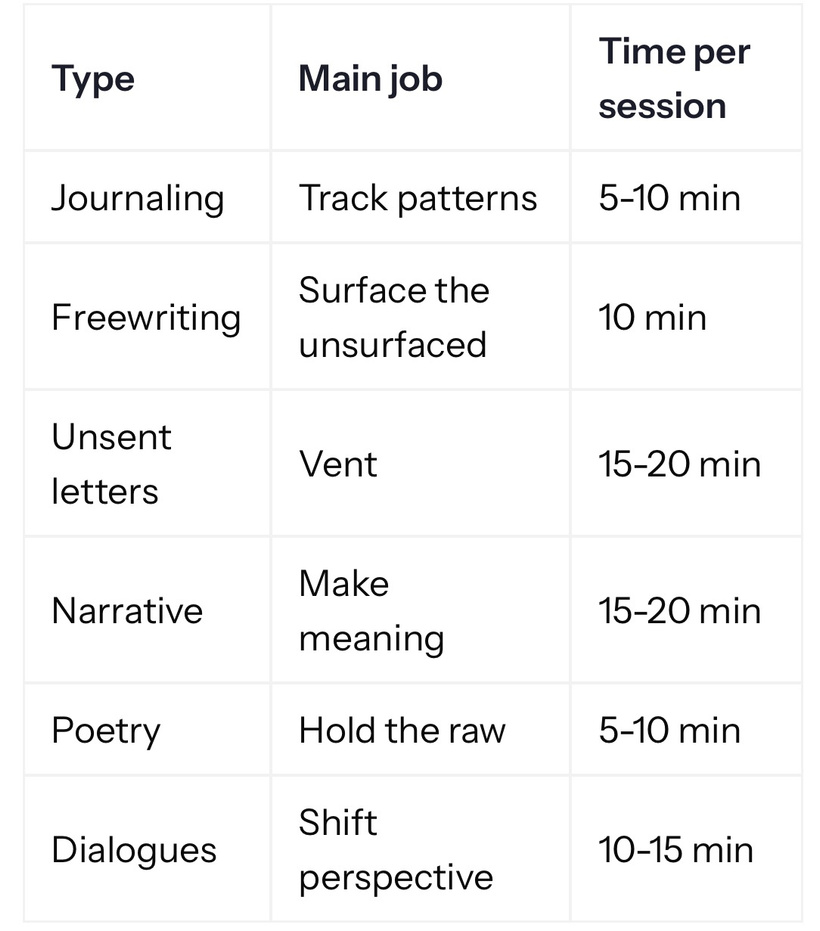
Six main formats serve different goals: journaling for tracking patterns, freewriting for venting, unsent letters for saying the unsaid, narrative for meaning-making, poetry for raw feelings, and dialogues for perspective-shifting.
The standard dose for processing trauma is 15-20 minutes across four consecutive days, then reassessing before starting another cycle.
Choose your format based on your goal: freewriting vents pressure, narrative writing makes meaning, and unsent letters or dialogues shift your perspective.
Switch formats when your current one stops working, such as moving from freewriting to narrative writing when venting stops producing resolution.
Types of Expressive Writing: Which Format Matches Your Goal?
The main types of expressive writing are journaling, freewriting, unsent letters, narrative trauma processing, poetry, and unsent dialogues, and each suits a different goal: venting, meaning-making, or perspective-shifting. This guide defines each format, shows the same stressful event written three ways, and gives you a decision table for picking the right one.
What are the main types of expressive writing and how do they differ?
Expressive writing is writing about emotional experience for yourself, not an audience. The original research paradigm asked participants to write about traumatic experiences for 15-20 minutes on three to four consecutive days, and those writers showed measurable health improvements over months compared with controls (Pennebaker & Beall, 1986). Six formats do different jobs.
Journaling and diary writing
Ongoing entries that record events, moods, and patterns over time. Best for tracking emotional patterns and spotting triggers.
Freewriting
Nonstop writing for a set period without editing or stopping. Best for bypassing self-censorship when you don't know what you feel yet.
Unsent letters
A letter to a person, living or dead, that you never send. Best for venting and saying what was never said.
Narrative / trauma-processing writing
Structured retelling of an experience with a beginning, middle, and aftermath. Best for meaning-making: turning a fragmented memory into a coherent story.
Poetry and fragment writing
Short, image-heavy pieces. Best for experiences too raw for full sentences.
Unsent dialogues
Imagined two-way conversations, writing both parts. Best for perspective-shifting with someone you can't talk to.
MindScribber supports several of these formats.
What are some examples of expressive writing in everyday life?
You already use several expressive writing formats without naming them. Venting a raw, unfiltered paragraph into your notes app at 2 a.m. is freewriting. The message you typed to an ex or a parent and never sent is an unsent letter, one of the most direct formats for saying what you could not say in person.
Other everyday examples:
A diary entry recounting a fight with your partner, then circling back to what it reminded you of from childhood, is narrative or trauma-processing writing.
A imagined conversation written as dialogue, where you answer for the person who hurt you, is an unsent dialogue.
A few lines about a hard week that happen to rhyme or carry a metaphor count as poetry; the compression forces you to name the feeling precisely.
Standard mood logging, like tracking a bad day in MindScribber’s mood tracker, is adjacent but thinner: it records emotion without examining it.
The distinguishing feature is not the medium but the goal. Venting releases pressure, meaning-making connects events into a story, and perspective-shifting lets you hear your own words back.
How does expressive writing differ from journaling or diary-keeping?
Most journaling is record-keeping: what happened today, who you saw, what you ate. Expressive writing is different in both aim and structure. In James Pennebaker's paradigm, you write continuously about a difficult experience for 15–20 minutes, focusing on your deepest thoughts and feelings rather than events, over several consecutive sessions. A meta-analysis of 146 studies found these structured writing exercises produce measurable health benefits, though effect sizes are modest and vary by outcome (Smyth, 1998).
The practical difference matters if you're processing trauma. A diary entry says "had a fight with my sister." Expressive writing asks what the fight meant, how it connects to older wounds, and what you felt but didn't say. MindScribber builds its prompts around that second mode.
Which type of expressive writing works best for processing difficult emotions?
For trauma processing specifically, Pennebaker-style narrative writing has the strongest track record: write about a distressing experience in depth across consecutive sessions, connecting events to feelings and to your current life. That maps to the narrative/trauma-processing format, with unsent letters as a close second when the experience involves a specific person you cannot address directly.
When venting is the goal
Pure venting is freewriting's job: set a timer, write without stopping, do not edit. It lowers immediate arousal but rarely produces lasting change on its own, so treat it as a pressure valve rather than a protocol. Journaling with mood tracking works here too, because seeing emotional patterns over time tells you which days actually need the valve.
When meaning-making is the goal
Meaning-making needs structure, not speed. Narrative writing that rebuilds the event as a coherent story, or an unsent dialogue where you write both sides of a conversation, forces you to organise fragments into cause and effect. That structure is what separates a processed memory from a rehearsed one. Our own app, MindScribber, leans toward this structured end.
How do you choose an expressive writing format for a specific goal?
Start with the goal, not the format. If you need to vent, freewriting works: set a timer, write without stopping, don't edit. If you need to make sense of something, narrative writing is the better fit, because it forces you to order events and locate causes. If you need to shift perspective, an unsent letter or unsent dialogue puts you in someone else's position, which is hard to do while venting in your own voice.
The dose matters as much as the format. A meta-analysis of 146 expressive writing studies found the strongest effects came from protocols of three to five sessions, with sessions of at least 15 minutes each, spread over days rather than crammed into one sitting (Frattaroli, 2006, meta-analysis of expressive writing interventions). That means one intense session is not the protocol; a short series is.
Switch formats when a goal stops being met. If freewriting keeps circling the same anger without resolution, that is your cue to move to narrative writing. If a narrative feels flat and analytical, an unsent letter reintroduces the emotion. Whatever you choose, MindScribber is built around these protocols, though it cannot decide your goal for you; that judgment stays yours.
What does expressive writing look like in practice—a worked example?
Here is the same experience, a fight with your sister, written three ways.
Version 1: freewrite (venting)
"She did it again. Interrupted me at dinner, made that joke about my apartment, and I just sat there smiling like an idiot. I'm so sick of swallowing it. Why can't I ever say anything in the moment? I'm shaking and I don't even know why."
This version gets the heat out fast. No structure, no editing, just the raw emotion on the page. It works best when you are flooded and need to discharge before you can think.
Version 2: unsent letter (perspective-shifting)
"Dear S., when you joked about my apartment, I heard the old message that I've failed. I know you probably meant nothing by it. But I want you to understand why I went quiet."
Writing to her instead of about her forces you to imagine her side while still naming your hurt. That shift is the point of this format.
Version 3: narrative reframe (meaning-making)
"The dinner joke landed the way it did because in our house, teasing was how our mother expressed disapproval. I went quiet because I learned that defending myself made things worse. That pattern is mine to unlearn, not proof that I'm weak."
This version connects the moment to a larger story and points toward change. It is the hardest to write and usually the most useful, but it works better after the first two have cooled you down.
How often and how long should you practice each type of expressive writing?
The standard dose comes from Pennebaker's original protocol: write for 15-20 minutes on four consecutive days, then reassess. That schedule produced measurable health benefits in his first controlled trial (Pennebaker & Beall, 1987). Most people don't need daily sessions long-term; a cycle of four days, then a break of a week or more, works better for narrative and unsent-letter work.
Freewriting and mood tracking tolerate higher frequency, since they release pressure rather than dig into core wounds. Unsent dialogues are best capped at one per week, because they stir up the other person's voice.
Two safety notes: if a session leaves you flooded for more than an hour or two, shrink the topic to the edges of the memory rather than its center, and pause the practice entirely if you're currently in crisis. Research-oriented readers should know the evidence base also shows some writers feel worse short-term, which is a known pattern, not a failure.
Can an app support an expressive writing practice?
An app can hold the structure: prompts, streaks, mood tracking, and a private space to write. It cannot do what a trained therapist does, and the honest tools say so.
Run the six against this article's criteria and the split is clear. Day One and Daylio handle journaling and mood tracking well but offer no trauma-processing formats. Rosebud and Wysa add AI feedback and 24/7 conversation, useful for venting and perspective-shifting. Reflection focuses on structured reflection prompts.
MindScribber covers freewriting, unsent letters, and narrative formats with research-based protocols, which fits the meaning-making goal directly. Where it falls short: no AI dialogue and no human support.
What are some examples of expressive writing?
Venting an unfiltered paragraph into your notes app at 2 a.m. is freewriting. A message typed to an ex and never sent is an unsent letter. A diary entry that circles back to a childhood memory is narrative writing. A few metaphor-heavy lines count as poetry, and a dialogue where you answer for the person who hurt you is an unsent dialogue.
Is expressive writing the same as journaling?
No. Most journaling is record-keeping: what happened, who you saw, what you ate. Expressive writing focuses on your deepest thoughts and feelings about an experience rather than the events themselves. A diary entry says "had a fight with my sister"; expressive writing asks what the fight meant and what you felt but didn't say. The aim and structure differ.
How long should I do expressive writing for trauma?
Follow Pennebaker's protocol: 15-20 minutes per session across four consecutive days, then reassess. A meta-analysis of 146 studies found the strongest effects came from three to five sessions of at least 15 minutes, spread over days rather than crammed into one sitting. After a cycle, take a break of a week or more before starting another.
Can expressive writing make me feel worse?
Yes, short-term. Some writers feel worse immediately after a session, which is a known pattern in the research, not a sign you're doing it wrong. If a session leaves you flooded for more than an hour or two, shrink the topic to the edges of the memory. Pause the practice entirely if you're currently in crisis.
What type of expressive writing should I start with?
Start with the goal, not the format. If you need to release pressure, try freewriting: ten minutes, no stopping, no editing. If you're processing a specific difficult experience, narrative writing is the stronger fit, but it works better once a freewrite or unsent letter has cooled the initial emotion. Switch formats when your current one stops producing progress.